
The term ‘neocloud’ may not have the most favourable connotations for channel partners desperate to secure the latest kit for their customers.
After all, it’s this new breed of cloud provider – along with the hyperscalers – who we’re told are ahead of them in the queue as the memory shortage deepens.
Now an analyst has shed more light on the growth of this emerging market, and the identity of its key players.
Here are 3 things you need to know…
How large is the neocloud market?
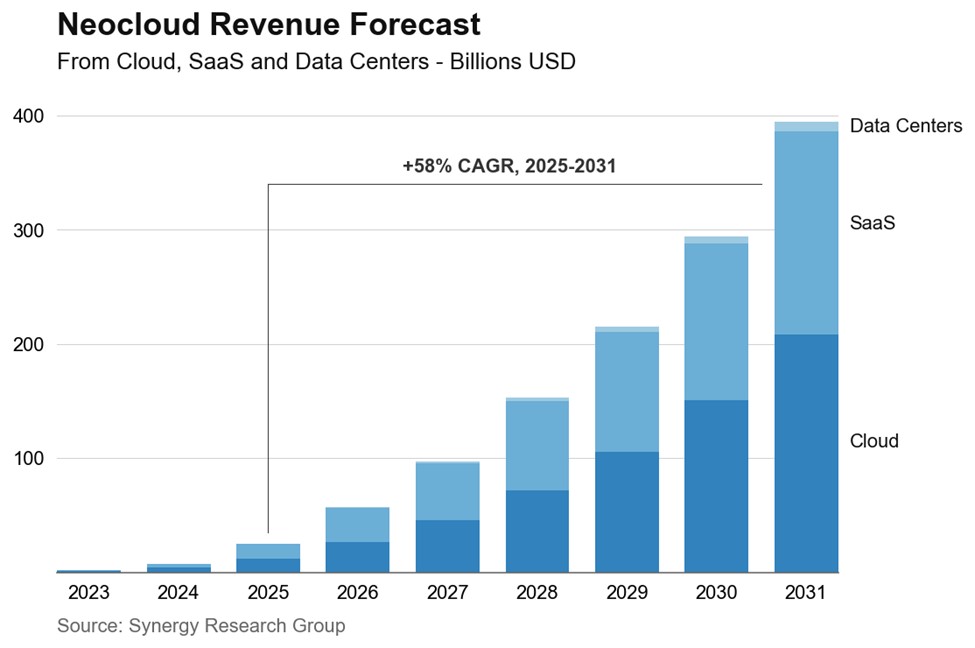
According to Synergy Research Group, the neocloud sector is “scaling at an unprecedented rate”, with revenues booming 223% year on year to $9bn in Q4.
It characterises neoclouds as “a distinct and rapidly scaling category of cloud infrastructure, purpose-built to deliver high-performance, GPU-centric computing for artificial intelligence workloads”.
Driven by surging demand for AI infrastructure, the neocloud market will grow at a CAGR of 58% to hit nearly $400bn by 2031, Synergy predicts.
What are neoclouds?
The term ‘neocloud’ only emerged in 2024 – now it’s everywhere. So what are they, exactly?
According to Synergy, neoclouds are positioning themselves as focused alternatives to the traditional hyperscaler trio of AWS, Microsoft Azure and Google.
“Traditional hyperscale systems were conceived around a form of generalised elasticity, whereas AI workloads impose far more rigid constraints – particularly around parallelism, locality and the concentration of compute,” stated Synergy Research Group Founder and Chief Analyst Jeremy Duke.
“Neoclouds are, in effect, an architectural response to those constraints. As AI moves from exploratory phases into sustained, large-scale deployment, these underlying differences cease to be incidental and instead become determinative of how compute systems evolve.”
Who are the key neoclouds?
Synergy picked out CoreWeave, Crusoe, Core Scientific, Lambda, Nebius and Nscale as among the leading neocloud providers.
Fingered by the analyst as “the most direct challenger” to the traditional hyperscalers, CoreWeave claimed in February that it had become “the fastest cloud in history” to top $5bn in annual revenue.
The New Jersey-based outfit’s share price soared 11% on Friday after it announced it has entered a multi-year agreement with Anthropic to power its Claud artificial intelligence models.
Denver-based Crusoe in October raised $1.375bn at a valuation of above $10bn, meanwhile.
At the centre of Sir Keir Starmer’s plans for the UK to become an artificial intelligence hub, London-based NScale last month announced a $2bn Series C funding round valuing it at $14.6bn.
It is one of two European neoclouds named above, alongside Amsterdam based Nebius.