
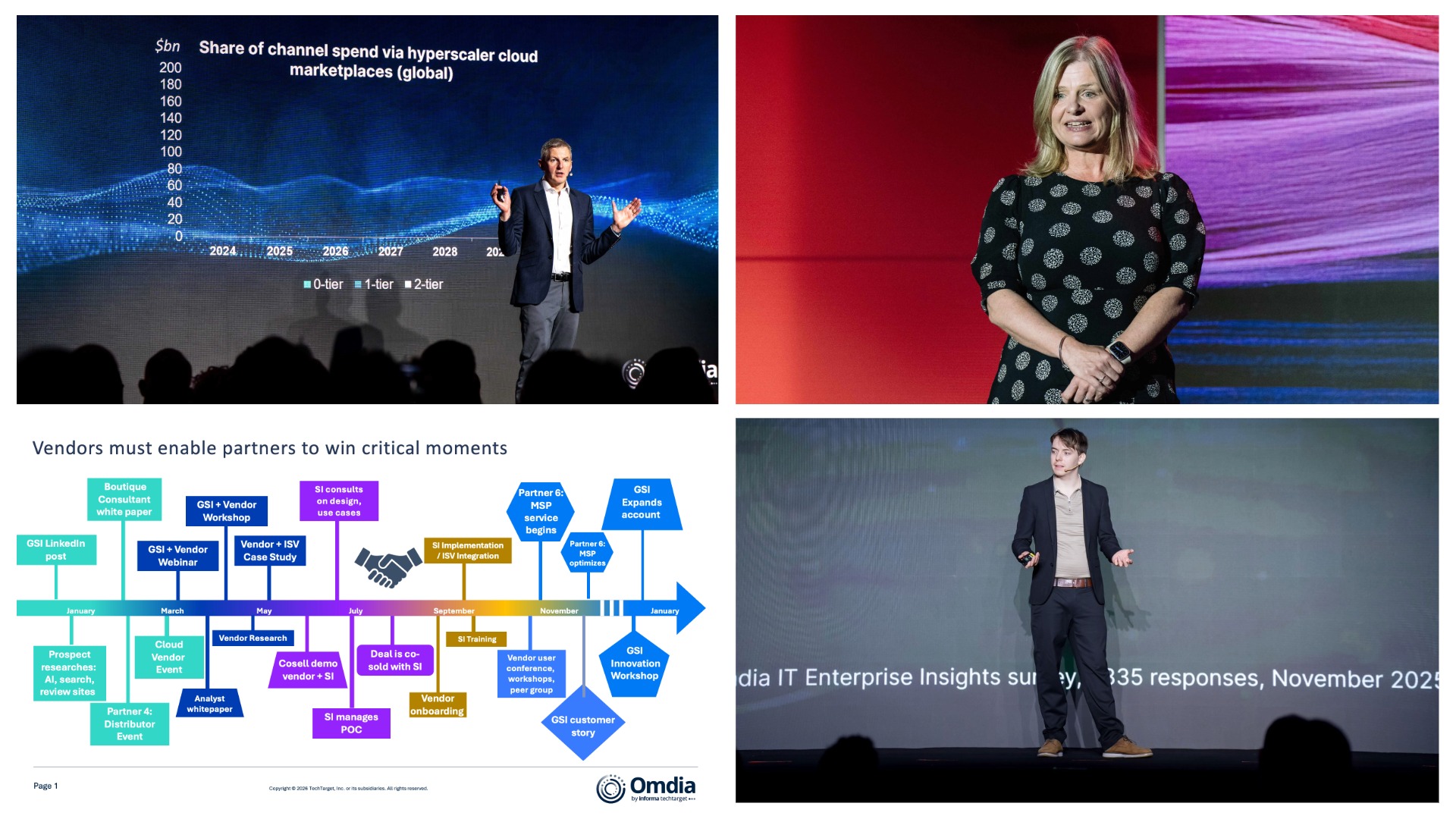
The great and the good of the IT channel earlier this month descended on Blackfriars to hear four Omdia analysts share their views on how the industry will evolve.
Here we round up six eye-catching claims and observations from the day.
“It’s a challenge for partners to adopt this in many cases, but [hyperscaler marketplaces] is a practice we think every partner should be investing in. Because if you don’t, you’re missing this business.”
In his opening keynote, Chief Analyst Alastair Edwards spoke of the need for partners to devise a strategy for hyperscaler marketplaces, a route to market Omdia forecasts will be worth $163bn by 2030.
Customers are increasingly using hyperscaler marketplace commits to purchase third-party cybersecurity and business applications (with multiple vendors now shifting billions of dollars of software via AWS Marketplace alone – see here).
But they are also “struggling” to define how to use them, Edwards said.
“They don’t necessarily all know how they can take advantage of this, and they are asking for partners to be involved,” he said.
Spotting this trend, the hyperscalers have in recent years moved to invite partners to the marketplace table, initially through one-tier models such as AWS’ Channel Partner Private Offer (CPPO), Microsoft’s Multiparty Private Offer (MPO) and Google’s Marketplace Channel Private Offer (MCPO).
Most of the big partners – most recently SCC – have since devised fully fledged hyperscaler marketplace battleplans.



More recently, the big three hyperscalers have moved to add distributors into the loop.
AWS has appointed at least a dozen distributors through its Designated Sellers of Record (DSOR) programme, with Microsoft unveiling Resale Enabled Offers (REO) in November and Google its Distributor Channel Private Offer (DCPO) scheme in April.
Although distributors are being “cut out of the mix” on channel partner private offer deals, distribution will ultimately be “key” to the model, Edwards opined.
“The models to support distribution are still being developed, and as a result distributors are now facing a bit of a challenge from marketplaces as that adoption grows,” he said.
“But distribution remains critical, and we spend a lot of time looking into the distribution landscape and understanding how that space is transforming.”
Article continues on following page…