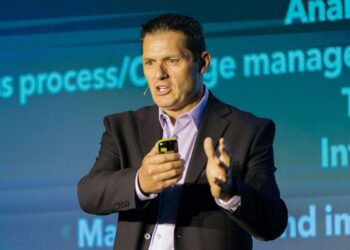

A fractional IT sales leader who once got sacked by his Dad claims he’s part of a rising trend of skilled execs offering their services in the channel on a part-time, flexible basis.
Fractional leadership is reshaping how businesses – including those in the fast-moving IT channel – access senior executive talent, its proponents argue.
And according to one of the growing number of IT channel pros with ‘fractional’ in their job titles, the trend is being stoked not only by the current economic and hiring backdrop, but also AI.
Having amassed 13 years of IT sales experience at IT peripherals distributor JLC Distribution, Jack Walsh in May launched his own venture, JWI Commercial.
“Before it would have taken me all day”
Walsh said he’d spotted that a lot of JLC’s reseller and telecoms clients were “quite old school” in how they approached sales and other aspects of leadership.
Thanks to the rise of new AI tools, hiring a fractional leader enables them to tap into experienced talent who can hit the ground running, Walsh claimed.
“You can now be so much more effective, but you don’t have to be full time,” Walsh said.
“A lot of these organisations, if they get the wrong hire, it can set them right back – that was the idea behind JWI Commercial.”


How exactly has AI changed the equation for those in Walsh’s position?
Whereas previously prospecting, writing pitch decks or carrying out market research would have been a full-time job, now solo entrepreneurs can now lean on AI to perform these functions on a part-time basis for several companies at once, Walsh claimed.
“I can sit at my desk and have 100 leads that fit my ICP [ideal customer profile] ready to go,” he explained.
“I’ve got emails, numbers and LinkedIn, and I can just start running the sequence. I can do that far more effectively. I can run it throughout the day, where it will be softly reaching out on my behalf, and then when I get a response, it’s me that takes the wheel.
“I think that applies to a lot more fractional roles out there. You’ve got these bits of software that can support a singular person, whereas before that would have taken me all day.”
“He invited me to leave the business”
Walsh’s IT channel journey started in 2013 when he joined JLC – then known as Jammy Lizard – as a warehouse packer, before going on to grow its corporate business.

“A friend of mine – James Lake – used to run it,” he recalled.
“I’d actually just got fired by my Dad’s stationery company.
“One of my earliest memories was of him in the office selling, so I always thought that was going to be my destiny.
“But there’s probably something about working for family – I think I just took it for granted, didn’t really try, and ultimately he invited me to leave the business at the end of 2012.”
Walsh has given himself six months to make his new venture work, with JLC signing on as one of his first clients.
Fractional fortunes
Fractional leaders get the benefit of being their own boss, while the companies hiring them gain access to better talent than they might otherwise be able to afford – and for a period and frequency of their choosing, Walsh said.
Stephen Halpin, whose company, PortfolioXD, specialises in providing ‘C-Suite as a Service’, claimed fractional leadership is the perfect low-risk option for growth organisations in the fast-paced IT channel. Having launched in 2023, it now claims to have over 2,500 C-suite execs on its books.
“Technology, AI and changing expectations around work are clearly making it easier for experienced executives to support multiple businesses,” he told IT Channel Oxygen.
“But I think the more enduring story is that, for the first time, founder-led companies are no longer constrained by the executive experience they can afford to access.
“Historically, when a business reached a critical inflection point – raising investment, expanding internationally, building an executive team to support rapid growth or preparing for exit – it often had to navigate that journey without leaders who had experienced it before, simply because that experience was beyond its reach.”
Fractional leadership roles aren’t right for just anyone, with PortfolioXD knocking back over a third of C-Suite candidates looking to join its ranks, Halpin stressed, however.
“It’s now seen as quite a nice way of making a living, and we’re finding two sides that are not quite fitting,” he said.
“One is people with not enough C-suite experience to give us the comfort of putting them into the companies that we’re working with.
“But we’ve also got the other end of the scale – namely those from big organisations who are taking the redundancy payments and think they can walk straight into an actual C-suite role within an SME.
“I think that that sounds great on paper, but culturally, operationally, that becomes quite difficult at times.”

Channel pro Ruth Schofield – who has in the past operated as a fractional channel leader – acknowledged that there are some drawbacks to the model.
“For start ups and scale ups it’s much lower risk,” she said.
“But I don’t think you can replace (even with AI advancements) having someone on the payroll from a commitment and ownership perspective. Also customers and partners tend to gravitate to vendors with someone in a permanent post, especially for senior roles. Senior roles primarily drive culture, which partners and customers tend to trust when they can see a robust culture in place. That’s harder to achieve in fractional roles because they tend to be temporary or part time.”
“They can move around businesses freely, adding serious value”
Does the rise of fractional leaders mean permanent, full-time C-suite leaders are coming under more pressure to justify their roles?
“I’d say if one is already installed, potentially not. But growth is always attractive to CEOs – and now a fresh pair of eyes is available at much less risk to the business,” Walsh responded.
“I’ve spoken with a number of fractional C-suite, and they can just move around businesses quite freely and adding serious value, because they’ve spent a number of years within an organisation or within a sector,” he concluded.

Doug Woodburn is editor of IT Channel Oxygen